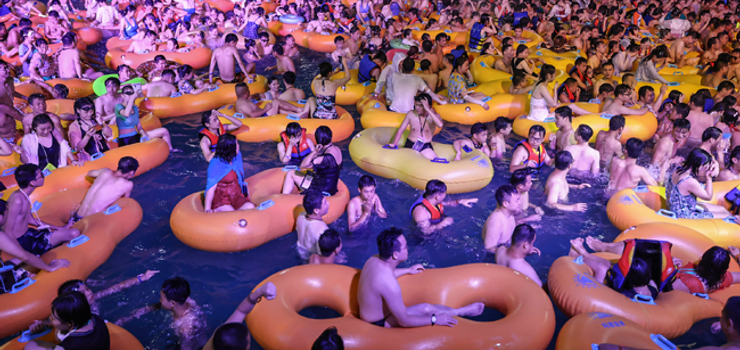
A massive pool party attended by thousands of people at the epicentre of the coronavirus pandemic showed how well China had dealt with disease, authorities insisted Thursday, despite images from the event prompting outrage around the world.

Pictures and video of the weekend electronic music party in Wuhan — where COVID-19 first emerged in December 2019 — have gone viral, attracting a huge negative response in places where lockdowns are still in effect.

The headline “Life’s a beach in Wuhan as world pays virus price” — splashed across the front page of Australia’s Daily Telegraph — was typical of some mainstream news headlines, while comments on social media sites were more colourfully frank.

China’s nationalist Global Times newspaper hit back against what it called “sour grapes” abroad.

AFP’s video of the event has been viewed more than 16 million times since it was posted.

One Twitter user called the event “incredibly irresponsible”, while another suggested there was “no way” it would not lead to more cases of coronavirus.

Under fire

But China said Thursday the pool party showed the city’s “strategic victory” against the outbreak, and said the images were proof the country’s approach to controlling the virus had been successful.

“I saw relevant reports by AFP, and it is said that people in Europe and America were very shocked,” foreign ministry spokesman Zhao Lijian told a press briefing.

This shows that Wuhan has won a strategic victory in its fight against the epidemic,” he said.

China has come under fire from around the world since the outbreak of the virus, which has infected over 22 million people and killed nearly 800,000.

Beijing has denied US accusations that China covered up the initial outbreak and handled it badly.

Zhao called on the media to “report the real situation in China” so people abroad could understand the country’s fight against the epidemic.

Wuhan has not reported any new virus cases in months after undergoing a draconian lockdown and strict restrictions earlier this year.

Source: AFP

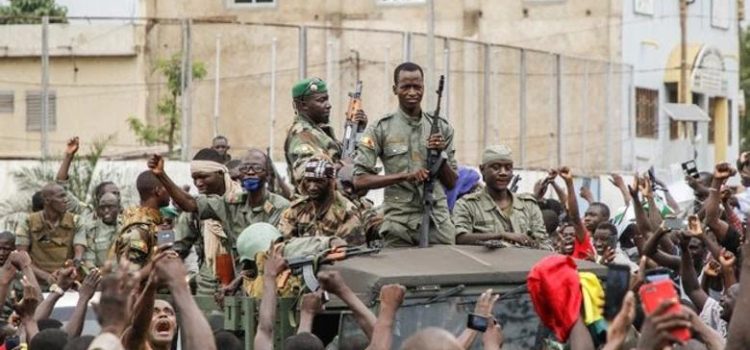
Mali awoke on Wednesday to a new chapter in its troubled history after rebel military leaders forced President Boubacar Keita from office, prompting its West African neighbours to threaten border closures and sanctions against the coup leaders.

Keita, embattled by months of protests over economic stagnation, corruption and a brutal Islamist insurgency, said he had resigned to avoid bloodshed.

There were few obvious traces of the previous day’s drama in the capital Bamako — there were no troops on the streets despite the coup leaders announcing a night-time curfew.

The burnt-out home of the former justice minister after an attack by protesters was one of the few visible signs of the overthrow.

Jubilant crowds had cheered the rebels on Tuesday as they arrived in Bamako, where they detained Keita along with Prime Minister Boubou Cisse.

UN Secretary General Antonio Guterres demanded the “immediate and unconditional release” of both men as diplomats in New York said the Security Council would hold emergency talks on Wednesday.

It was unclear whether Keita was still in custody on Wednesday at the Kati military base — a facility seized by the mutineers that was also the site of the 2012 coup that brought him to power.

The coup leaders appeared on television overnight to pledge a political transition and new elections within a “reasonable time”.

Malian Air Force deputy chief of staff Ismael Wague said he and his fellow officers had “decided to take responsibility in front of the people and of history”.

There were no reports of casualties during the military takeover but the coup leaders announced a curfew and border closures, in effect sealing off the country.

– Jihadist insurgency –

French President Emmanuel Macron was among the first to condemn the mutiny, his office saying that he still supported mediation efforts by other West African states.

Mali is the cornerstone of French-led efforts to roll back jihadists in the Sahel, and its neighbours are anxious to avoid the country sliding into chaos.

Colonel Wague said “all past agreements” would be respected, including Mali’s support for anti-jihadist missions in the region.

“MINUSMA (the UN force in Mali), (France’s) Barkhane force, the G5 Sahel, Takuba (a European special-forces initiative) remain our partners,” he said.

The coup leaders also remain “committed to the Algiers process,” a 2015 peace agreement between the Malian government and armed groups in the north of the country, he said.

Swathes of Mali’s territory are outside of the control of the central authorities.

Years of fighting have failed to brake an Islamist insurgency that has claimed thousands of lives since emerging in 2012.

The failure fuelled frustrations with Keita’s rule and tensions flared in April after the government held long-delayed parliamentary elections, the results of which are still disputed.

– Sanctions threat –

The Economic Community of West African States (ECOWAS) last month suggested the formation of a unity government while offering continued support for Keita, but the compromise was slapped down by the opposition.

ECOWAS condemned the coup in a statement, pledging to close land and air borders to Mali and push for sanctions against “all the putschists and their partners and collaborators”.

The 15-nation bloc — which includes Mali — also said that it would suspend the country from its internal decision-making bodies.

Further afield, Morocco on Wednesday stressed the need for “stability” in Mali, calling for “responsible dialogue, respect for constitutional order and the preservation of democratic gains.”

The coup coincided with opposition plans to resume protests against Keita.

The June 5 Movement, named after the date of its first protest, focussed public anger against the leader and made increasingly strident demands for his resignation.

Its campaign veered into crisis last month when 11 people were killed during three days of unrest sparked by a demonstration.

Source: AFP

Ace Nigerian rapper, Folarin Falana, popularly known as Falz, has called on the Federal Government to reopen the entertainment industry.

The son of human rights lawyer, Femi Falana, made this known in a string of tweets on Monday shortly after the Minister of Aviation, Hadi Sirika, announced August 29 as the reopening date for international flights.

Like most public places, cinemas and other recreational outlets were shut in March to curtail the spread of the coronavirus pandemic.

But while some public places like markets, banks, airports, amongst others have been allowed to reopen, cinemas, beaches and other places of relaxation remain closed.

Reacting, Falz wrote, “Restaurants have reopened, airlines have been operating, places of worship have also been permitted to reopen. Let’s not even start to talk about all the videos that have surfaced of political rallies happening, clearly neglecting all safety precautions

Right now, we don’t see anything but a government that contributes little or nothing to its creative sector and continues to attempt to stifle the sector in every way. Thousands of people have been left without any way to earn for several months.

The entertainment industry must be allowed to gradually get back in business. Let’s start with cinemas reopening with all safety precautions in place.”

Also, a lawmaker representing Egbeda/Ona-Ara Federal Constituency in the House of Assembly, Akin Alabi, tweeted, “It’s no longer making sense that cinemas are still closed. They have assured the government and the public that they are ready to open at less than half capacity. Planes are flying full capacity. Parties are going on. Don’t let me mention rallies.”

A tweep, @Gregzetta, wrote, “Cinemas have demonstrated their ability to properly conduct business in a safe manner. It makes little sense keeping cinemas shut while local flights operate, restaurants are open for in-dinning and places of worship open. Open cinemas now.”

martinskachi1 argued, “If you allow domestic flights to resume, there is absolutely no reason why cinemas shouldn’t. The operations are exact. Same queueing process, same boarding and ticketing process, same seating process, everything!”

Nigerian music star, Wizkid, has ‘smiled’ his way into the ears of Barack Obama, making the former US president’s 2020 summer playlist.

Wizkid, whose real name is Ayodeji Balogun, is at No. 15 with his new single “Smile”, featuring American Grammy winner, H.E.R.

Obama shared the selection with his followers on Twitter on Monday evening, in continuation of an annual tradition.

“Over the past few months, I’ve spent a lot of time listening to music with my family

“I wanted to share some of my favorites from the summer, including songs from some of the artistes at this week’s @DemConvention. Hope you enjoy it,” he wrote.

Nigerian-American rapper, Chika, also featured in the list with her uplifting single, “Crown”.

The list features 53 songs from a range of genres, including reggae, hip-hop, country, pop, and rock.

American RnB superstar, Beyoncé, also made the list with “Already” from her new visual album, “Black is King.”

Others in the collection are Rihanna, Bob Marley, OutKast, Nas, J. Cole, Nina Simone and Frank Ocean among others.

Eilish, Leon Bridges, The Chicks, Common and Jennifer Hudson, who also made the list, were scheduled to perform at the ongoing National Convention of the Democratic Party.

Robert S. Trump, the younger brother of President Trump, died on Saturday night at NewYork-Presbyterian Hospital in Manhattan. He was 71.

The White House did not provide a cause of death. “He was not just my brother, he was my best friend,” the president said in a statement late Saturday night. “He will be greatly missed, but we will meet again.”

Robert Trump, who took blood thinners, had experienced brain bleeds that began after a recent fall, according to a close friend of the family’s.

Robert Trump, three years younger than the president, had been in poor health since last month. Over the past few weeks, he had not been able to speak on the phone, according to the family friend.

Donald Trump made a trip to Manhattan on Friday to see him at the hospital, a visit that lasted just under an hour.

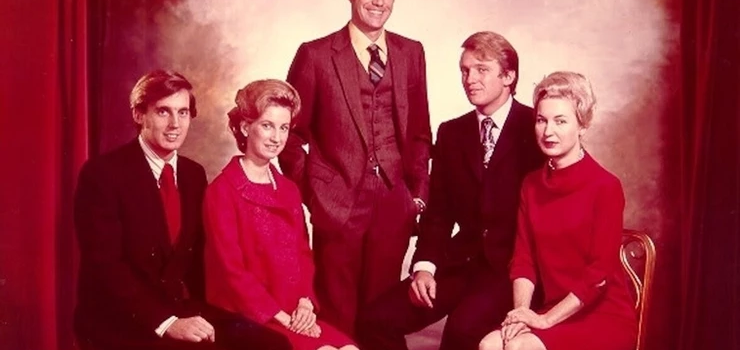
The brothers with their wives.

On Saturday, when Robert Trump was not expected to live much longer, the president called into the hospital from his Bedminster, N.J., golf club. A short time later, the president held a wide-ranging news conference, where he refused to say whether Kamala Harris was eligible to run for national office, giving credence to a false assertion that Ms. Harris, born in California, was not eligible because her parents were immigrants.

He did not mention his brother’s health, but privately was down and struggling to understand the impending loss, according to friends who spoke to him.

“I have a wonderful brother,” the president said on Friday during a news conference at the White House before departing to visit him. “We’ve had a great relationship for a long time, from Day 1, a long time ago.” In fact, the two were estranged for years, before Mr. Trump’s run for the White House.

Robert Trump had no children, but he helped raise Christopher Hollister Trump-Retchin, the son of his first wife, Blaine Trump, even giving him his last name. Besides the president, he is survived by his second wife, Ann Marie Pallan, and his sisters, Maryanne Trump Barry and Elizabeth Trump Grau. His brother Fred Trump Jr. died in 1981.

As the youngest of five children growing up in the strict Queens household of Fred C. Trump, Robert Trump was shielded from some of the pressure exerted by his disciplinarian father over his older brothers. He was never groomed to take over the family real estate company, and was considered by those who knew him to be the inverse of the brash, self-promotional brother who eventually did. After graduating from Boston University, he first went to work on Wall Street, instead of immediately joining the family business. But he eventually went to work for his brother as a senior executive at the Trump Organization.

“You could consider him the quietest of Trumps,” Michael D’Antonio, a Trump biographer, said. “He was glad to stay out of the spotlight.”

Jack O’Donnell, a former Trump Organization executive who worked closely with the Trump family, recalled the younger Mr. Trump as someone with a natural ease and good humor that his older brother lacked.

He was dignified, he was quiet, he listened, he was good to work with,” Mr. O’Donnell said. “He had zero sense of entitlement. Robert was very comfortable being Donald Trump’s brother and not being like him.”

That was not always an easy gig, and simply being a close family member did nothing to shield him from his brother’s stormy rages when he needed someone to blame. Family friends said that as Donald Trump’s star grew, Robert Trump struggled with working for his brother, and actively cultivated an image as someone who was the polar opposite of the better-known Trump.

But Donald Trump still faulted Robert Trump, for instance, for the problems with slot machines that plagued the opening of the Taj Mahal casino in Atlantic City, N.J., in 1990, and cost him tens of millions of dollars in lost revenue. Donald Trump had put his brother in charge of the property after a helicopter accident in 1989 killed three Trump Organization executives who had been overseeing it.

But gaming regulators did not allow the casino to open because of a complete lack of financial control of the slot machines. On opening night, only a small section of the casino floor was open, and it was months before the slot machines were fully activated.

In one meeting, Mr. O’Donnell recalled Donald Trump losing his temper and screaming at his brother, telling him that he pinned all of the blame on him. “Robert calmly got up, walked out of the room, and that’s the last time I ever saw him,” Mr. O’Donnell said.

After the blowup, Robert Trump stopped reporting directly to his brother and removed himself from the core of the business, working out of the Brooklyn office and dealing with real estate projects in boroughs outside Manhattan that were in the family’s portfolio. But people who knew him said he was devastated by the fight with Donald Trump, and the rift between them took years to heal. During the years Robert Trump worked in Brooklyn, he would take his father, Fred Trump Sr., who at the time had Alzheimer’s disease, out for lunch every day at Gargiulo’s, an Italian restaurant, a friend recalled.

He reconciled with his brother when Donald Trump decided to run for president, according to a person close to the family. Robert Trump had in recent years been a loyal family spokesman and consigliere since his older brother entered politics. “I support Donald 1,000 percent,” he told The New York Post in 2016. “If he were to need me in any way, I’d be there. Anything I could do to help.”

He followed through with that promise. In recent months, he led the family in its unsuccessful bid to block the publication of a memoir by their niece Mary L. Trump — the daughter of their deceased older brother, Fred Trump Jr. — that described decades of family dysfunction and brutality that she claimed turned Donald Trump into a reckless leader. It was the president’s younger brother who requested the restraining order in a filing in Queens County Surrogate’s Court.

Before that, Robert Trump spearheaded the family response in 1999 when Mary Trump and her brother, Fred Trump III, sued for their father’s share of the family estate.

Robert Trump, who for 25 years was married to Blaine Trump, was more accepted in society circles and on the charity circuit than Donald Trump ever was, Mr. D’Antonio said.

But after a public and painful divorce in 2009, involving tabloid coverage documenting his decision to leave his marriage for an employee at the Trump Organization, Ann Marie Pallan, Robert Trump sought a quiet, retired life on Long Island.

He and Ms. Pallan married only earlier this year. On her Facebook page, Ms. Pallan has recently advertised Trump boat parades — part of the campaign’s effort to demonstrate enthusiasm for the president’s re-election — in the New York City area.

The relationship between the brothers — the older one dominating, the younger having to live with it and submit — was illustrated by Donald Trump in his book, “The Art of the Deal.” In it, he recalled stealing his younger brother’s blocks and gluing them together so that he couldn’t reclaim them. “That was the end of Robert’s blocks,” he wrote proudly.

The president’s decision to visit Robert Trump in the hospital at the end of his life was different from how he handled news in 1981 that his older brother, Fred Trump Jr., was in poor health. According to Mary Trump’s account, Donald Trump went to the movies the night Fred Trump Jr. died. Fred Trump Sr., the patriarch, also did not visit him.

But Gwenda Blair, a biographer of the Trump family, said that in light of the crack that Mary Trump’s memoir has put in the Trump family lore, the president would have had no choice.

“It’s very much part of the Trump family legend that they are a tight-knit, loyal group,” she said. “That is the family modus operandi. Mary Trump has recently suggested otherwise, but I think as part of the response to that, Donald Trump would have no choice but to go.”

Source: The New York Times

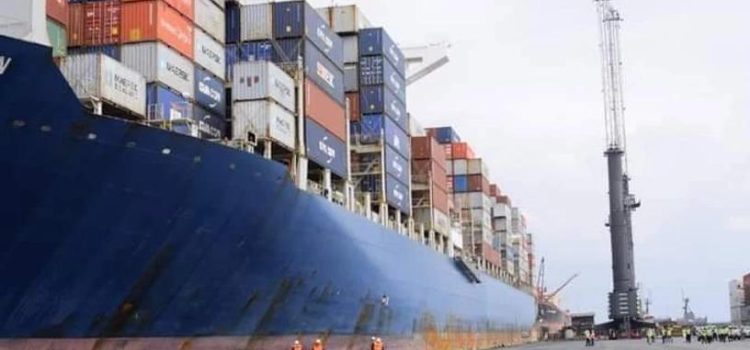
The Nigerian Ports Authority on Sunday announced the berthing of the biggest container vessel to ever dock at a Nigerian port.

General Manager, Corporate and Strategic Communications, Mr. Adams Jatto, made the announcement in a statement in Lagos.

Jatto said the Maerskline Stardelhorn vessel, with length overall of 300 metres, width of 48 metres was received at the Federal Ocean Terminal, Onne, Rivers State, at 16:20 hours on August 15.

He added that the vessel, which had a capacity of 9,971(TEUs) was a flagship from Singapore.

“The vessel, which was brought in from Fairway Bouy Bonny, with the aid of three Tugboats, operated by three of NPA’s pilots was received by the Manager of the Onne Ports, Mr Alhasssan Abubakar.

“NPA is delighted to state that the landmark arrival of the biggest gearless Maerskline vessel at Onne Ports is a result of management’s determination to improve the patronage of the Eastern Ports.

It is an indication of the fact that the Eastern Ports are equipped to receive all manners of vessels and an expansion of the options of consignees in the eastern and northern parts of the country.

“The management of the NPA congratulates its team at Onne Ports

Management also appreciates all stakeholders at the Onne Ports for their cooperation toward seeing that the vessel berthed safely without any challenge.”

Jatto assured that the NPA was committed to ensuring that all ports in Nigeria worked optimally with Nigeria being the economic hub of the West African sub-region.

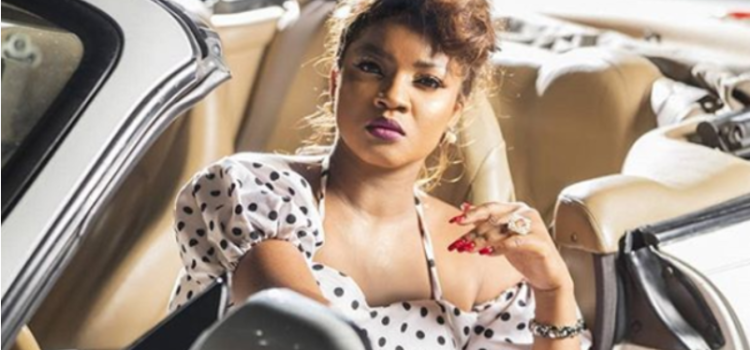
Nollywood star actress Omotola Jalade Ekehinde has joined the list of Nigerian celebrities such as Peter Okoye, who have tested positive to the coronavirus.

Omotola Saturday said she is in isolation and doing well after testing positive for the COVID-19 virus.

The actress took to her verified Instagram page to share her recovery progress.

“Hello all, I know you must have been wondering where I’ve been,” she said. “Well, I contracted Covid. I have been ill, in isolation, and now getting better.”

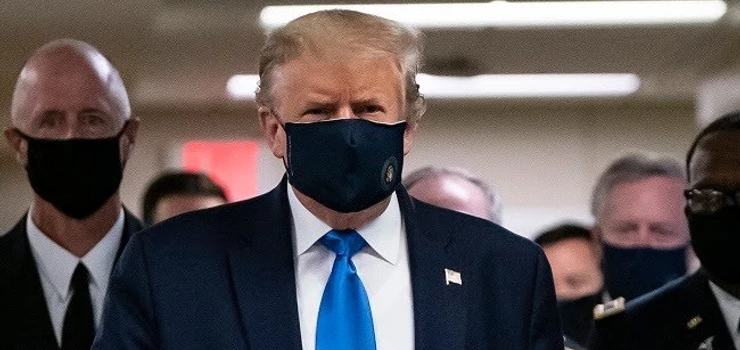
US President Donald Trump on Friday visited his younger brother Robert at a hospital in New York, where he is being treated for an undisclosed illness.

The US leader, who was wearing a face mask upon arriving at New York-Presbyterian Hospital, entered through a back door and stayed about 45 minutes, according to an AFP reporter covering the trip.

US media reports say the president’s brother is seriously ill, although there were no details.

Trump, who was stopping in New York on the way to his golf club in nearby Bedminster, New Jersey for the weekend, told reporters only that “he’s having a hard time.”

While far less famous than his older brother, Robert Trump has long been an integral part of the family real estate empire and is fiercely loyal to the president.

Robert Trump unsuccessfully went to court to try and get an injunction preventing publication of a book by his niece Mary Trump, called “Too Much and Never Enough: How My Family Created the World’s Most Dangerous Man.”

The book, which paints Donald Trump as the product of a “toxic” family was a “disgrace,” Robert Trump said. Although a temporary restraining order was applied, a judge lifted this in July, allowing publication.

At a press conference, President Trump called his brother “wonderful” and said they have “had a great relationship for a long time, from day one.”

-Source: AFP

30 guests to be allowed at post wedding sitdown reception

More beauty treatments, small wedding receptions and live indoor performances will be able to resume in England from Saturday, as lockdown rules are eased.

Bowling alleys, casinos and soft play centres will also be able to reopen, PM Boris Johnson has announced.

It comes as the government introduces tough new measures targeting breaches of social distancing restrictions.

Fines for refusing to wear a mask could reach a maximum of £3,200 and illegal rave organisers face a £10,000 penalty.

“Most people in this country are following the rules and doing their bit to control the virus, but we must remain focused and we cannot be complacent,” Mr Johnson said.

“That is why we are strengthening the enforcement powers available to use against those who repeatedly flout the rules.”

The changes coincide with new quarantine measures for people coming to the UK from several countries including France and the Netherlands , which mean travellers must self-isolate for 14 days from Saturday.

The prime minister said that plans to open up more of the economy this weekend “will allow more people to return to work and the public to get back to more of the things they have missed”.

But Mr Johnson reiterated a warning that the government “will not hesitate to put on the brakes if required, or to continue to implement local measures to help to control the spread of the virus”.

Under changes coming into force from 15 August:

Indoor theatre, music and performance venues will be able to reopen with socially distanced audiences

Wedding receptions in the form of a sit-down meal for up to 30 guests will be permitted

The piloting of a small number of sporting events to test the safe return of spectators will resume, commencing with the final of the World Snooker Championship at Sheffield’s Crucible Theatre over the weekend

Casinos, bowling alleys, skating rinks and soft play centres will be allowed to reopen

“Close contact” beauty services such as facials, eyebrow threading, eyelash treatments, make up application and microblading will resume

Pilots will take place at conference venues ahead of the expected resumption of business events from 1 October at the earliest

The new guidance will not apply in areas where local lockdown measures are in place, the government said.

Lockdown restrictions were last week introduced in Preston and kept in place in 18 other areas to control outbreaks.

Devolved administrations in Scotland, Wales and Northern Ireland have the power to set their own timings for the easing of restrictions.

The latest easing of England’s lockdown was due to take place on 1 August, however this was postponed after the ONS expressed concerns about a slight increase in the number of people in England testing positive for coronavirus.

Last week, ONS figures showed this may be levelling off .

New guidance will also mean that staff offering “close contact” services, including hairdressers, will now have to wear a face mask as well as a clear visor.

The government said the move, which follows new evidence from the scientific advisory group for emergencies (Sage) is aimed at protecting customers and staff from respiratory droplets caused by sneezing, coughing, or speaking.

It also applies to businesses that operate remotely, such as massage therapists working in people’s homes, and those learning in vocational training environments.

Nightclubs, dance halls and discotheques are among venues that remain closed in law.

Tougher enforcement measures

Under current guidance, people who refuse to wear a face covering where it is required face a £100 fine, which can be reduced to £50 if paid within 14 days.

The new enforcement measures will see that penalty repeatedly doubled for subsequent offences, up to a maximum of £3,200.

In England, face coverings are mandatory in many indoor settings, including public transport, shops and museums, with some exemptions for children or on medical grounds.

Transport for London and British Transport Police have already made 91,501 interventions based on present face coverings guidance, the government said – preventing 4,397 from boarding, asking 3,030 to leave the network and issuing 341 penalty notices.

There will also be a clampdown on illegal gatherings of more than 30 people, which could see those responsible hit with spot fines of up to £10,000.

According to the government, forces across England and Wales have already stepped up patrols to prevent illegal gatherings in areas of concern, such as Leicester and Greater Manchester, where it said deployments have sometimes been larger than on New Year’s Eve.

Last weekend, West Midlands Police shut down 125 parties and raves – and closed a pub – taking action to stop illegal gatherings and anti-social behaviour across the region.

Further detail on the new enforcement measures is to be set out in the coming week.

Home Secretary Priti Patel said she would not allow progress against the virus to be undermined by “a small minority of senseless individuals”.

“These measures send a clear message – if you don’t cooperate with the police and if you put our health at risk, action will follow.”

Source: BBC

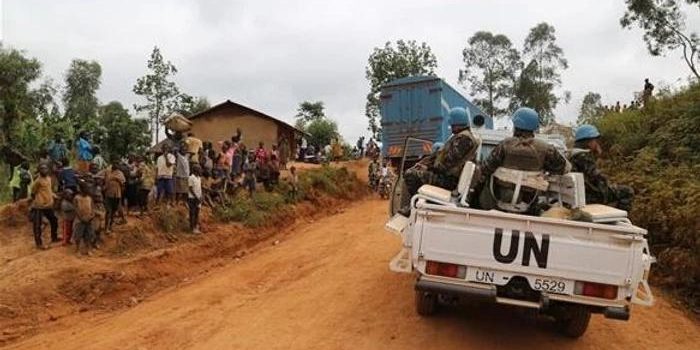
The coronavirus pandemic not only threatens gains in fighting global poverty and building peace but risks exacerbating existing conflicts and generating new ones, the UN chief warned.Speaking at a United Nations Security Council (UNSC) video conference on Wednesday on sustaining peace during the pandemic, Secretary-General Antonio Guterres said the “unprecedented challenges from COVID-19 clearly risk pushing things in the wrong direction”.”The pandemic threatens not only hard-won development and peacebuilding gains, but also risks exacerbating conflicts or fomenting new ones,” he added.Guterres said his March 23 call for an immediate ceasefire in conflicts around the world to tackle the coronavirus led to a number of warring parties to take steps to de-escalate and stop fighting, but many did not.His predecessor as secretary-general, Ban Ki-moon, told the council: “It is truly astonishing that in response to this pandemic, the world has placed billions of people under lockdown, closed international borders, suspended trade and migration, and temporarily shut down a whole variety of industries – but has not managed to suspend armed conflicts.”Ban criticised the UNSC for wasting valuable months “in arguments over the details of the text” and not adopting a resolution until July 1 demanding an “immediate cessation of hostilities” in key conflict areas to tackle COVID-19.”This has weakened the message that this council needs to send to all warring parties: now is the time to confront our common enemy,” Ban said.And he said delayed council action “further aggravated the current volatile global security situations”The impact of COVID-19 on conflict-affected settings has been much worse than initially thought,” said Ban, who is a co-chair of the group of prominent world leaders founded by Nelson Mandela known as The Elders.He pointed to health and humanitarian ramifications, social cohesion, governance, the rule of law and threats to multilateralism that are jeopardising ongoing efforts to sustain peace, “or may even cause a reversal in hard-won peace and security gains to date”.Source : Aljazeerah